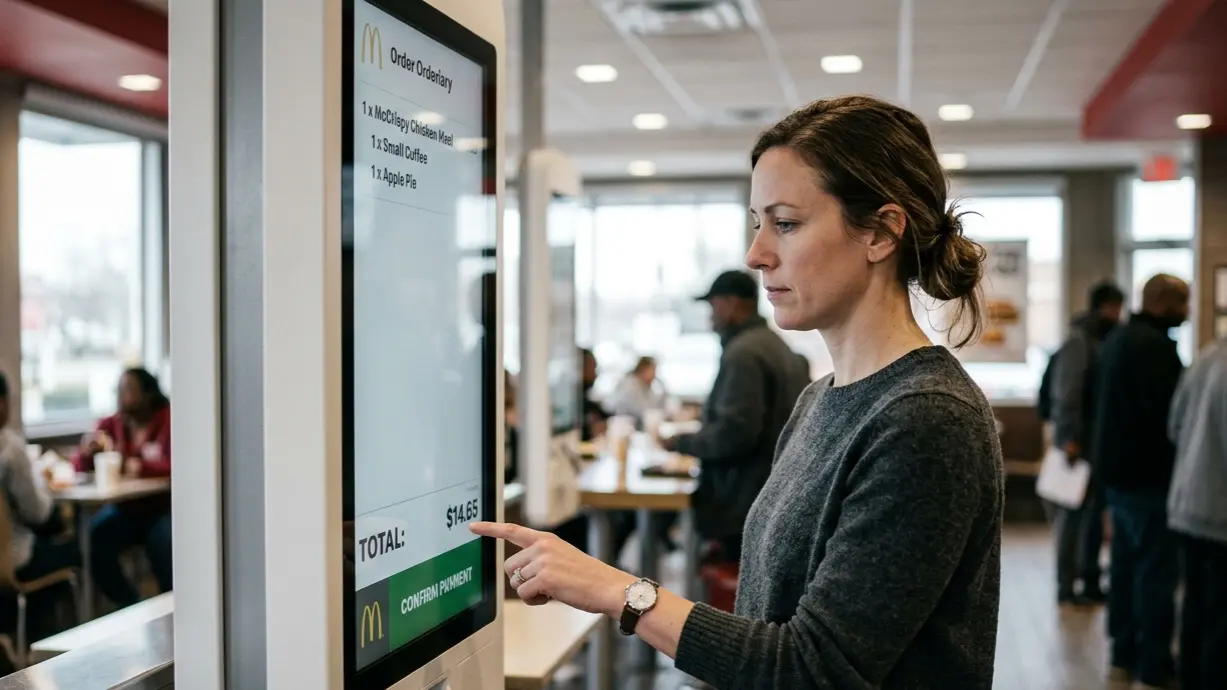
McDonald’s built its entire identity on being the affordable option. The place you go when money is tight, time is short, or both. That deal held for decades.
It doesn’t hold the same way anymore. Prices have risen enough that a significant share of American customers now hesitate before ordering, or skip it entirely. That hesitation is the story.
What McDonald’s Was Always Supposed to Be
For most of its history, McDonald’s operated on a simple promise: fast food at a price almost anyone could afford. A Big Mac combo in the early 2000s cost around $4–$5. The Dollar Menu launched in 2002 and became a cultural fixture.
Families, students, and low-income workers all relied on it as a dependable, low-friction meal. The brand didn’t compete on quality. It competed on accessibility. That positioning was its core strength, and it worked for over two decades without serious challenge.
Customers Started Noticing the Price Tag
The change didn’t happen overnight, but awareness reached a tipping point around 2023–2024. Customers began sharing receipts online, combo meals crossing $12, $14, even $18 in some markets. Social media amplified the sticker shock.
What changed wasn’t just the number on the screen. It was the psychological gap between what people expected to pay and what they were actually charged. McDonald’s had always been mentally categorized as “cheap.” Once that category no longer matched reality, the brand’s core value proposition started to feel broken, even to loyal customers.
Cost Pressures Rebuilt the Pricing Structure
McDonald’s didn’t raise prices arbitrarily. Input costs, food commodities, packaging, energy, rose sharply after 2020. More significantly, labor costs increased as states raised minimum wages and worker shortages pushed wages higher across the service sector.
Franchisees, who operate roughly 95% of U.S. locations, absorbed these costs and passed them forward through menu prices. Corporate had limited ability to control what individual franchise operators charged. The result was inconsistent but broadly upward pricing across the system, driven not by profit strategy alone, but by the compounding math of operating a labor-intensive, franchise-dependent business in an inflationary environment.
What the Data Actually Shows
The Bureau of Labor Statistics CPI data for “limited-service meals”, the category that includes fast food, rose approximately 33 percent between January 2020 and early 2025, outpacing both overall inflation and grocery price increases during stretches of that period.
This directly validates the consumer perception of fast food becoming less affordable. It isn’t anecdotal. The price increase is documented, measurable, and concentrated in a category that Americans historically relied on as a buffer against higher food costs. The data confirms that the affordability gap is real, not imagined.
How Customers Are Actually Responding
Behavior has shifted visibly. McDonald’s reported declining U.S. same-store sales in 2024, with traffic dropping among lower-income customers in particular. Some customers are trading down to grocery store prepared foods or home cooking.
Others are switching to competitors like Taco Bell or Wendy’s when value promotions are available. The $5 Meal Deal McDonald’s launched in mid-2024 was a direct response to this erosion, an acknowledgment that the brand had lost its price credibility with a meaningful segment of its own base. People aren’t boycotting. They’re quietly recalculating.
Where Things Stand
McDonald’s remains one of the highest-traffic restaurant chains in the United States. But its position as the default affordable option is no longer automatic.
Prices are meaningfully higher than they were five years ago. A portion of its core customer base, particularly lower-income households, has pulled back on visit frequency. The brand is actively running value promotions to recover that traffic. The affordability gap is real, documented, and currently unresolved.