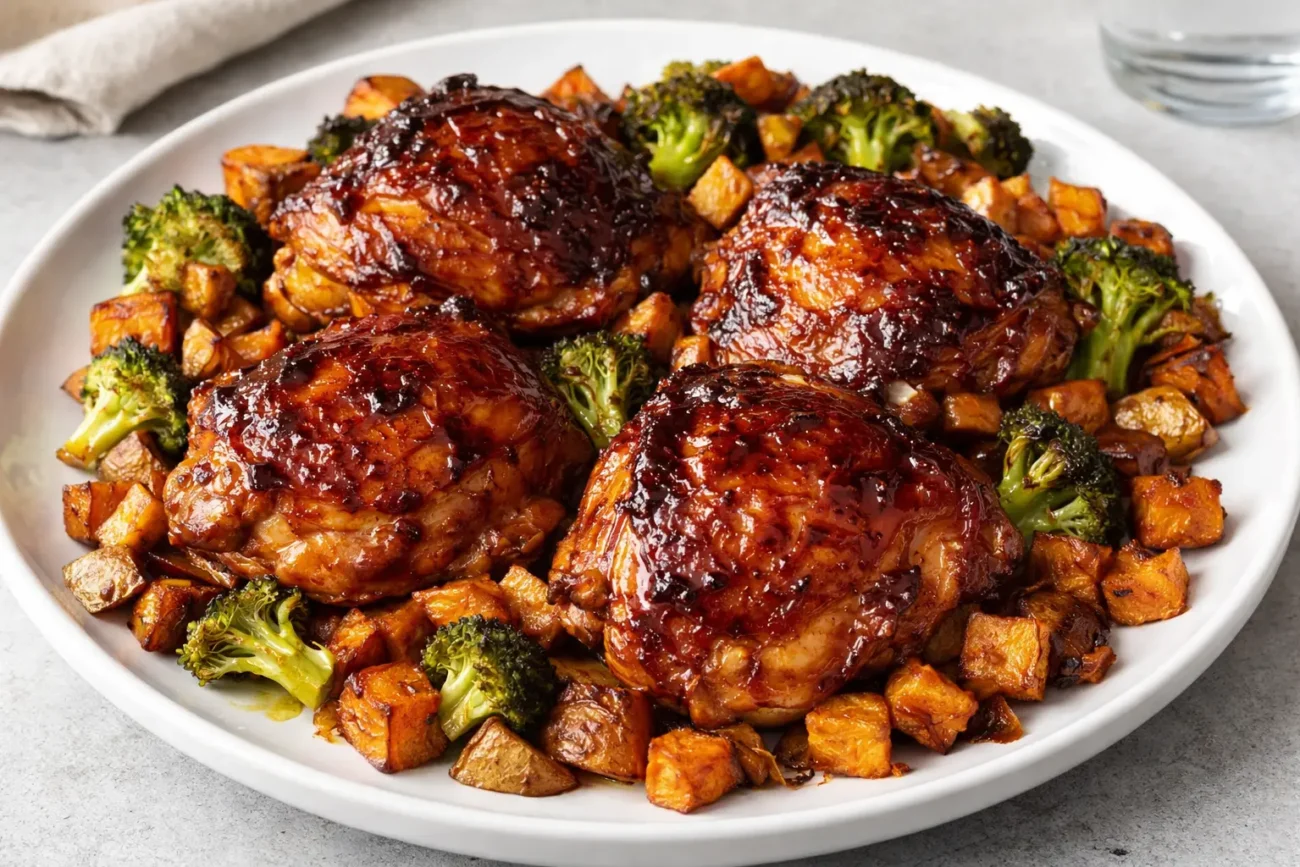
BBQ sauce behaves as a sugar-based glaze, not a marinade, and in a sheet pan oven environment that distinction determines whether it caramelizes into a sticky coating or burns into a bitter layer before the chicken finishes cooking.
A properly glazed piece of chicken emerges with a tacky surface that resists sliding when touched, indicating that sugars have thickened and adhered rather than scorched. This transformation depends on when the sauce meets the heat, not just how much is used.
Applying BBQ sauce only after the chicken surface has begun to dry allows it to bond and thicken instead of liquefying and burning. The method begins not with seasoning, but with sequencing.
How BBQ Sauce Changes the Roasting Environment
BBQ sheet pan chicken dinner preparation differs from other roasting methods because BBQ sauce introduces a high concentration of sugars, typically from molasses, brown sugar, or corn syrup, onto the surface of the protein.
These sugars begin caramelizing at moderate temperatures but quickly cross into burning territory under sustained high heat, especially above 375°F if exposed too early.
Unlike oil or dry rubs, BBQ sauce creates a semi-liquid coating that initially traps moisture against the chicken’s surface. If applied at the beginning of roasting, this moisture delays evaporation and prevents the surface from reaching the temperatures required for browning. The result is a pale exterior followed by rapid scorching once the water content evaporates and sugars are left exposed.
The defining characteristic of successful sheet pan BBQ chicken is controlled glaze formation—where sugars thicken and adhere during the final stage of cooking rather than breaking down prematurely.
Why Sauce Timing Controls the Entire Outcome
The most consequential decision in an oven baked BBQ chicken dinner is when the sauce is applied. Early application leads to two competing failures: steaming and burning. Late application resolves both.
During the first phase of roasting, the chicken surface must dry. This allows heat to concentrate and initiate browning reactions in the proteins and fats. If sauce is present during this stage, its water content interferes with evaporation, effectively lowering the surface temperature and preventing proper development.
Applying BBQ sauce in the final 8–12 minutes of cooking transforms it into a glaze rather than a coating. At this stage, the chicken surface is already hot and relatively dry, allowing the sugars to thicken and adhere quickly without prolonged exposure to high heat.
This staged approach treats BBQ sauce not as a marinade, but as a finishing layer that requires controlled exposure to heat to achieve the desired texture and flavor concentration.
Building a BBQ Sheet Pan Chicken Dinner That Roasts Evenly
A successful BBQ chicken and vegetables oven setup depends on aligning cooking times across all components on the pan. Chicken thighs are the preferred cut because their higher fat content slows moisture loss and supports longer roasting without drying out.
Vegetables must be selected and cut with their density in mind:
- Fast-cooking vegetables: bell peppers, zucchini, red onions
- Slow-cooking vegetables: potatoes, carrots
To synchronize doneness, dense vegetables should be cut smaller or started earlier. Alternatively, they can be positioned closer to the pan edges where heat exposure is more intense.
Uniform spacing is equally critical. Each ingredient must have enough surface exposure to allow moisture to escape. Overcrowding leads to steam accumulation, which disrupts both vegetable caramelization and chicken browning.
Equipment and Pan Setup That Prevents Steaming
The sheet pan itself defines the cooking environment. A rimmed, heavy-gauge aluminum sheet pan conducts heat efficiently and allows rendered fat to spread without pooling excessively.
Key setup principles:
- Use a large pan to maintain spacing between ingredients
- Avoid lining with materials that trap moisture (such as foil pressed tightly against food)
- Position the pan in the center of the oven for even airflow
Moisture evaporation is the governing factor here. As chicken releases water during cooking, that moisture must escape into circulating oven air. If trapped, it condenses and creates a humid microenvironment that prevents browning and delays cooking progress.
Step-by-Step Method for BBQ Sheet Pan Chicken Dinner
Key Recipe Summary
- Prep Time: 15 minutes
- Cook Time: 35–45 minutes
- Total Time: 50–60 minutes
- Servings: 4
- Cooking Method: High-heat sheet pan roasting
- Primary Equipment: Rimmed sheet pan, oven, thermometer
- Difficulty Level: Easy to moderate
Ingredients
- 2 pounds bone-in, skin-on chicken thighs
- 2 cups potatoes, diced into 1-inch pieces
- 1 cup carrots, sliced
- 1 cup bell peppers, chopped
- 1 medium red onion, cut into wedges
- 2 tablespoons vegetable oil
- 1 teaspoon salt
- ½ teaspoon black pepper
- 1 cup BBQ sauce
Ingredient Function
- Chicken thighs: Higher fat content supports sustained roasting without drying
- Oil: Facilitates heat transfer and promotes surface browning
- BBQ sauce: Provides sugars for glaze formation during final cooking phase
- Vegetables: Contribute moisture and require proper spacing for caramelization
Instructions
- Preheat oven to 425°F
Allow the oven to fully preheat. A hot oven ensures immediate moisture evaporation upon contact. - Prepare vegetables (5 minutes)
Toss potatoes and carrots with oil, salt, and pepper. Spread evenly on the sheet pan.
Visual cue: Pieces should not overlap. - Start roasting dense vegetables (10–15 minutes)
Place pan in oven to give slower vegetables a head start.
Cue: Edges begin to soften but not brown deeply. - Add chicken to the pan
Arrange chicken thighs skin-side up, spaced apart.
Cue: Skin should remain exposed, not covered by vegetables. - Roast without sauce (20–25 minutes)
Allow chicken to cook until surface begins to brown.
Cue: Skin appears slightly tightened and matte, not wet. - Apply BBQ sauce (final 8–12 minutes)
Brush sauce evenly over chicken.
Cue: Sauce begins to thicken and darken without smoking. - Check internal temperature
Use a thermometer to confirm 165°F at the thickest part. - Rest before serving (5 minutes)
Allows juices to redistribute and glaze to set.
What 165°F Actually Looks Like Before and After Glazing
Chicken reaches food-safe doneness at 165°F, as defined by USDA guidelines. At this point, muscle fibers have contracted enough to eliminate harmful bacteria while still retaining internal moisture.
Before glazing, the chicken surface appears lightly browned with visible rendered fat. After sauce application, the exterior darkens and becomes glossy as sugars concentrate.
Carryover heat continues to cook the chicken slightly after removal from the oven, stabilizing internal moisture and final texture.
Why BBQ Sheet Pan Chicken Burns or Turns Watery
Burning occurs when BBQ sauce is exposed to high heat for too long. Sugars degrade rapidly once water content evaporates, leaving behind a bitter residue.
Watery results stem from overcrowding. When too many ingredients share a confined space, released moisture accumulates faster than it can evaporate. This prevents both browning and glaze adhesion.
These two failures often occur together: early sauce application creates moisture, followed by burning once that moisture disappears.
FAQ: Sauce Timing, Temperature, and Pan Coordination
When should BBQ sauce be added to chicken in the oven?
During the final 8–12 minutes of cooking, after the surface has dried and begun to brown.
Can you cook BBQ chicken and vegetables on the same pan?
Yes, provided vegetables are cut and staged to match the chicken’s cooking timeline and spaced to allow airflow.
Why does BBQ sauce burn in the oven?
Because its sugars are exposed to high heat for too long without sufficient moisture to regulate temperature.
What temperature is best for BBQ sheet pan chicken dinner?
425°F provides the necessary heat for browning while minimizing total cooking time and supporting vegetable roasting.
How do you keep sheet pan chicken from drying out?
Use cuts with higher fat content and avoid overcooking beyond 165°F.
How long does leftover BBQ sheet pan chicken last?
Store in the refrigerator for 3–4 days. Reheat at 350–375°F to restore texture without drying.
BBQ as a Controlled Oven Glazing System
BBQ sheet pan chicken dinner is not defined by sauce alone but by the timing of its transformation under heat. Sugar, moisture, and airflow form a system in which each variable influences whether the surface browns, steams, or burns.
Treating BBQ sauce as a late-stage glaze rather than an early coating reframes the method entirely, turning what is often approached as seasoning into a controlled finishing process governed by heat exposure and surface conditions.
Editorial Transparency Statement
This article is research-based and informed by culinary science, official food safety guidelines, and established roasting technique principles. It does not rely on personal kitchen testing.
- USDA FSIS — Leftovers and Food Safety
- USDA FSIS — Safe Minimum Internal Temperature Chart
- USDA FSIS — Safe Handling & Reheating Guidance
