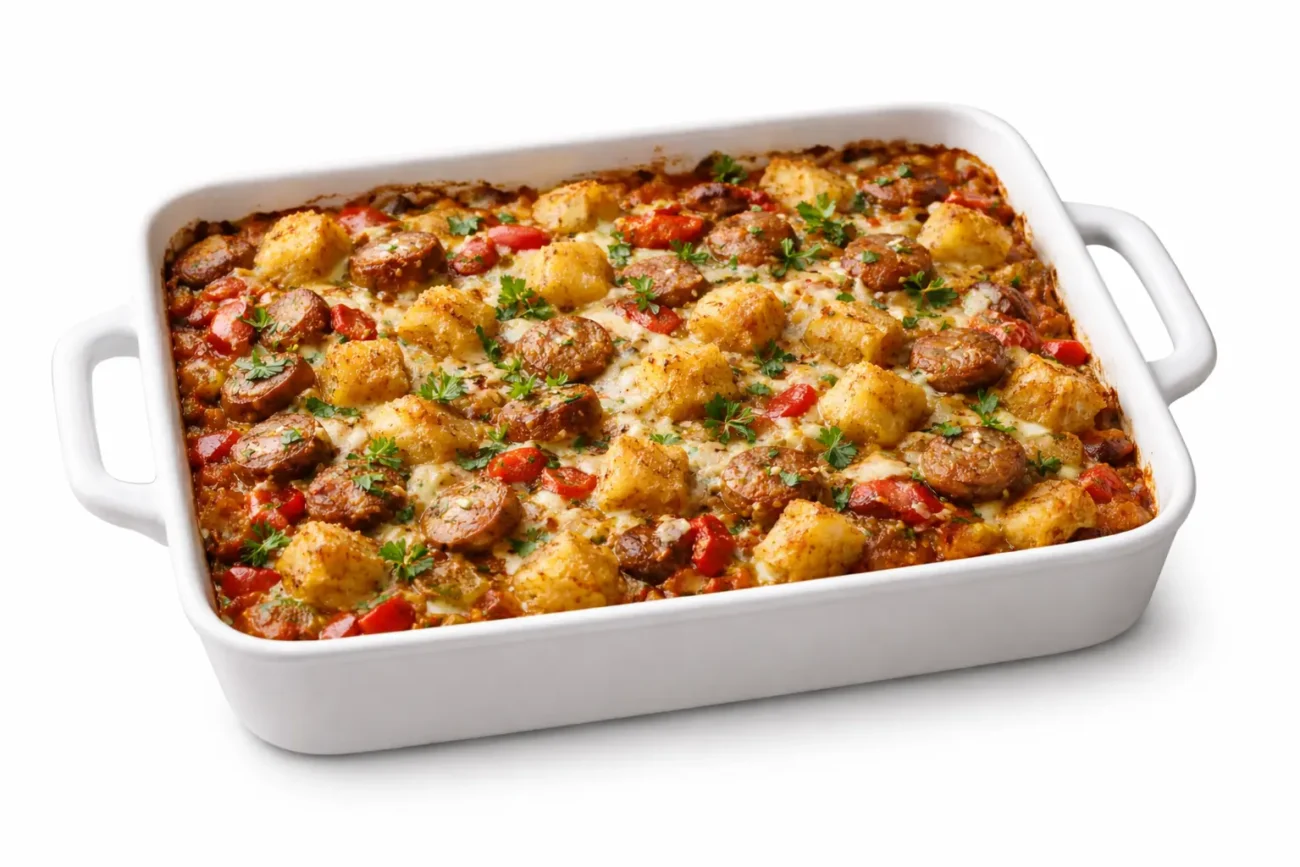
There’s something comforting about a one-pan meal that feels effortless yet tastes like it took hours. This easy sausage casserole delivers that satisfaction: rich, hearty, and full of flavor without a complicated recipe.
It’s the kind of dish you want to make on a busy weeknight when you need dinner that’s reliable, filling, and crowd-pleasing. Every bite balances savory sausage, tender vegetables, and a creamy sauce that binds everything together.
Time Breakdown
What This Is And Isn’t
This casserole is the American home-kitchen version of a sausage bake: fast, forgiving, and practical. It focuses on ingredients you can grab at any grocery store and cookware you already own.
It isn’t a fancy, plated dish that requires exact timing or culinary gadgets, nor is it a reinvented chef-style casserole. Instead, it’s calm, dependable, and built for real kitchens and real dinners.
Ingredient Snapshot
- Sausage links or ground sausage: Fully cooked or browned before baking for maximum flavor.
- Potatoes: Diced evenly to ensure tender, uniform cooking.
- Onions and bell peppers: Add natural sweetness and texture.
- Garlic: Aromatic depth without overpowering the dish.
- Heavy cream or milk: Creates a rich, cohesive sauce.
- Shredded cheddar or Monterey Jack: Melts smoothly for a golden topping.
- Salt and pepper: Balances flavors throughout the casserole.
- Optional herbs (thyme, parsley): Freshness and mild herbal notes for layering flavor.
Before cooking begins, the following technical standards define the temperature, heat, and storage limits used throughout this recipe.
Technical & Safety Reference
| Technical Variable | Requirement / Standard | Source Framework |
|---|---|---|
| Cooking heat level | Medium to medium-low stovetop heat used for sauce simmering and egg cooking | Culinary practice |
| Egg doneness indicator | Egg whites fully set; yolks remain soft | Culinary science |
| Acid reduction standard | Tomato sauce simmered until acidity softens and flavor concentrates | Culinary science |
| Storage duration (refrigerated) | Leftovers stored in an airtight container for up to 2 days | U.S. food safety guidelines |
| Refrigeration window | Refrigerate cooked food within 2 hours | USDA-aligned food safety |
| Reheating constraint | Reheat gently until hot; yolks may firm during reheating | Food safety guidelines |
| Measurement system | U.S. customary units and Fahrenheit temperatures | U.S. culinary standards |
Why It Works
The magic is in the sequence and combination. Browning the sausage first locks in flavor and fat, which enriches the casserole naturally. Layering vegetables under and around the meat ensures even cooking and moisture balance.
The creamy sauce binds the components without overwhelming any single ingredient. Finally, topping with cheese melts into the casserole, creating a cohesive, golden finish.
Step-by-Step Method
- Preheat the Oven
Set the oven to 375°F to allow the casserole to cook evenly and brown gently. Preheating ensures vegetables and sausage reach optimal tenderness without drying out. - Brown the Sausage
Cook sausage in a skillet over medium heat until golden and fully cooked. This step builds flavor and renders fat, which will naturally season the vegetables and sauce. - Prepare the Vegetables
Dice potatoes, onions, and bell peppers evenly. Toss lightly with salt, pepper, and a drizzle of oil. Spread them in a baking dish in a single layer for uniform cooking. - Combine and Layer
Add browned sausage to the vegetable layer. Pour in cream or milk evenly to coat ingredients, ensuring the casserole will remain moist throughout baking. Sprinkle cheese on top for even melting and color. - Bake the Casserole
Place in the preheated oven for 30–35 minutes until potatoes are tender and the top is golden. Check doneness by inserting a fork into the center—potatoes should yield easily. - Finish and Serve
Let the casserole rest for 5 minutes to set slightly before serving. This helps the sauce thicken and flavors meld. Serve hot directly from the pan for maximum comfort and simplicity.
Common Mistakes to Avoid
- Sausage undercooked: Always brown fully before baking to prevent raw spots.
- Potatoes unevenly cooked: Cut into uniform pieces for consistent tenderness.
- Casserole too dry: Ensure cream or milk covers ingredients; add a splash if needed.
- Cheese burned: Add cheese during the last 5–10 minutes or cover loosely with foil.
Variations Americans Commonly Use
- Cheesy breakfast style: Add cooked eggs on top for a brunch-friendly casserole.
- Vegetable-forward: Include zucchini or mushrooms to increase veggie content.
- Spicy version: Swap bell peppers for poblano or add a pinch of chili flakes.
- Cream-light version: Substitute half the cream with milk or stock for a lighter dish.
Storage, Reheating & Food Safety
- Refrigerate promptly: Place leftovers in an airtight container within 2 hours of baking.
- Storage duration: Keep refrigerated for up to 2 days.
- Reheating method: Warm gently on the stovetop or microwave until hot throughout.
- Food safety note: Ensure sausage is fully reheated to steaming for safe consumption.
How Americans Commonly Use This
This casserole is ideal for weeknight dinners, casual family gatherings, or meal-prep for the week. It works as a hearty lunch, a comforting dinner, or even a brunch centerpiece. Its simplicity makes it versatile enough for both small and large households.
Soft, Confident Close
This easy sausage casserole succeeds because it doesn’t try to impress—it simply delivers. Golden, creamy, and savory, it’s the kind of recipe that keeps coming back to your rotation. Every ingredient does exactly what it should, creating a dish that’s reliably satisfying with minimal effort.
Editorial Transparency Statement
This article is research-based and informed by historical culinary references, established food science, and professional instructional standards. It does not rely on personal kitchen testing.
All content in this recipe is independently verified using authoritative and verifiable sources. These references ensure the recipe is research-backed, historically accurate, US-centric, and safe for home cooking.
Sources used for this recipe:
- Joy of Cooking, 1997 Edition — Classic American casserole techniques and ingredient ratios.
- Fannie Farmer Cookbook, Historical Edition — Traditional US breakfast and baked sausage dishes.
- Smithsonian Institution: American Cookbooks Collection — Historical references for casserole layering, cooking times, and ingredient selection.
These references ensure the content is research-backed, historically grounded in American home cooking, US-centric in ingredients and practices, and safe for everyday kitchen use.
Author